

From elite academies to Sunday league, the game is woven into daily life across the city. Whether you are playing competitively or simply enjoying a weekly match with friends, football demands speed, strength, coordination, and resilience.
Unfortunately, injuries are part of the sport.
What separates players who return stronger from those who struggle with recurring pain is not just rest. It is structured, professional football injury rehabilitation. At Hekas, we work with footballers at every level. Our focus is not just on helping you recover. We’ll help you rebuild properly so you return to the pitch stronger, more confident, and more resilient than before.
Why Football Injuries Require Specialized Rehabilitation
Football is different from many other sports. It combines sprinting, sudden direction changes, jumping, tackling, and repetitive kicking. An athlete’s body must react quickly under pressure, often while fatigued.
This explains why football injuries are rarely simple.
A hamstring strain may not just be about tight muscles. An ankle sprain may not only be about swelling. Often, there are deeper issues involved such as movement imbalances, muscle weakness, poor load management, or reduced joint stability.
General rest may reduce pain temporarily, but it does not prepare your body for the explosive demands of football.
That is why football injury rehabilitation in Manchester must be sport-specific, progressive, strength-focused, and built around real match demands
At Hekas, we design rehabilitation programmes that reflect how football is actually played, not just how injuries look on paper.
5 Common Football Injuries We See in Manchester
Academy player or recreational athletes in Manchester are likely to experience any of these five common injuries:
These often occur during sprinting or sudden acceleration. Many players return too soon and experience repeat strains because the muscle has not regained full strength at high speed.
- Anterior Cruciate Ligament (ACL) Injuries
ACL injuries usually happen during sharp changes in direction or awkward landings. Rehabilitation is long and requires structured strength and neuromuscular training.
- Groin and Hip Pain
Football places heavy strain on the groin due to repeated kicking and cutting movements. Without proper strengthening, groin pain can become persistent.
- Ankle Sprains
Ankle sprains are common during tackles or uneven landings, and are often underestimated. Poor rehabilitation can lead to long-term instability for the athlete.
- Knee Pain and Overuse Injuries
Training frequency, hard surfaces, and increased competition schedules contribute to knee stress injuries.
Each of these injuries requires more than rest. They require a structured plan that rebuilds strength, control, and confidence.
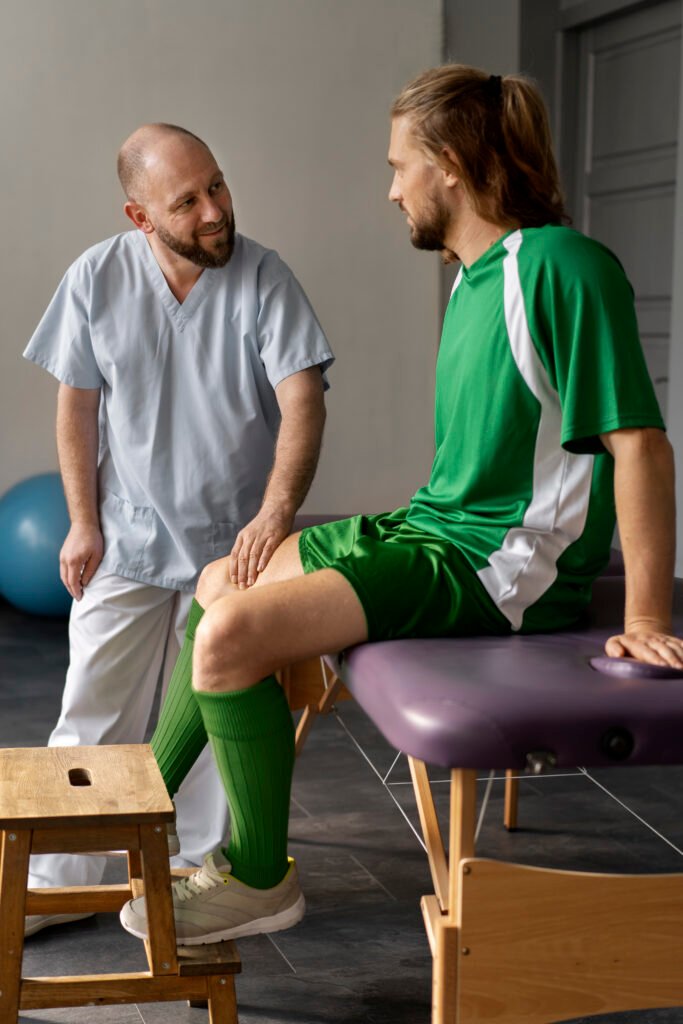
Step-by-Step Guide on How Hekas Handles Football Injury Rehabilitation in Manchester
Step 1: A Thorough Assessment
At Hekas, football injury rehabilitation begins with a detailed assessment.
We do not simply look at where it hurts. We assess how the injury occurred, your training history, movement patterns, muscle strength and balance, stability under load with sprinting and functional control (when appropriate)
This allows us to identify not only the injury but the root cause. If we only treat symptoms, the injury is likely to return. If we address the cause, we improve long-term durability.
Step 2: A Personalised Rehabilitation Plan
We understand that no two players are the same.
A 16-year-old academy winger has different demands from a 32-year-old Sunday league defender and we ensure that their rehabilitation reflects that.
Your rehabilitation plan may include:
- Pain Reduction and Early Management
In the early stage, we reduce inflammation and protect the injured area while maintaining safe movement.
- Strength Restoration
We rebuild strength progressively. Football injuries often reduce power and muscle activation. Strength must be restored under controlled conditions before returning to full play.
- Movement Retraining
We correct faulty movement patterns. This might involve improving landing mechanics, sprint form, or hip control.
- Football-Specific Conditioning
Before returning to match play, you must tolerate football-specific loads. This includes acceleration, deceleration, cutting, and reactive movements.
We gradually increase intensity so your body adapts safely.
Step 3: Strength Training
Many players believe stretching alone will solve their injury. While flexibility matters, strength is the foundation of resilience.
Football requires explosive force. If muscles are weak or unbalanced, other body structures will compensate and lead to overload and further injury.
Our programmes at Hekas focuses on hamstring strength at long muscle lengths, hip stability, core control, single-leg power, ankle stability with knee tracking and control
When strength improves, confidence follows.
Step 4: Returning to Football Safely
One of the biggest mistakes we see is returning to play too early. “Pain-free” does not always mean match-ready. A safe return to football involves many staged progression and we help you handle that.
At Hekas, we guide players through each phase carefully. Our goal is not just quick return. It is durable return.
Stage 5: The Mental Side of Football Injury
Injuries do not just affect the body, they affect confidence.
Many players returning from injury hesitate during tackles or sprints. This hesitation can change movement patterns and increase risk. Part of our football injury rehabilitation in Manchester involves restoring trust in your body.
We achieve this by gradual exposure to football movements and objective strength testing. We’ll measure your performance based on milestones and clearly communicate progress at every step.
When you see measurable improvement, confidence grows naturally.
Why Local Footballers Choose Hekas in Manchester?
At Hekas Sports Rehabilitation, we provide detailed injury assessments, individualised rehabilitation plans, strength and conditioning integration with sports massage support where appropriate. We follow a clear return-to-play progression
We understand the demands of Manchester football culture. Since training schedules are busy, ur programmes are realistic, structured, and tailored to fit your life while prioritising recovery.
After completing rehabilitation, we also provide guidance on warm-up strategies, load management, strength maintenance, recovery practices, and mobility routines
Many footballers who complete structured rehabilitation notice improvements in sprint speed, stability, and endurance because their training becomes more balanced and intentional.
Returning stronger is not a slogan. It is the result of structured progression.
General physiotherapy may reduce pain, but football injury rehabilitation prepares you for repeated sprints, rapid deceleration, contact situations, and direction changes under fatigue. The pitch is unpredictable, so your rehabilitation must prepare you for unpredictability.
At Hekas, we simulate these demands safely and progressively so your body adapts in stages.
When Should You Seek Football Injury Rehabilitation in Manchester?
You should seek football injury rehabilitation in Manchester if:
- Pain persists beyond a few days
- Swelling does not settle
- Strength feels reduced
- You have repeated injuries in the same area
- You feel unstable during play
- You are returning from surgery
Early intervention reduces downtime. The sooner a structured plan begins, the better your long-term outcome.
How Long Does Football Injury Rehabilitation Take?
Your specific recovery time is dependent on the severity of the injury involved.
Minor muscle strains may improve within weeks if managed properly, while ligament injuries may require months of structured rehabilitation.
What matters most is not speed but progression.
We focus on criteria-based rehabilitation rather than time-based return. You move forward when your body demonstrates readiness, not when a calendar says so.
You do not need to be a professional player to deserve professional care.
We work with academy players, semi-professional athletes, university teams, Sunday league players, youth footballers, and recreational players
Every player’s recovery matters to us at Hekas
Hekas Will Help You Return Stronger!
At Hekas, football injury rehabilitation in Manchester is built around long-term resilience.
We do not rush recovery or apply generic programmes. We do not overlook underlying weaknesses either. We assess thoroughly, strengthen properly, and progress gradually as you prepare for a return.
Football injuries are frustrating, but they do not have to define your season.
Returning to football after injury should not feel uncertain. With the right guidance, it becomes structured and achievable.
With structured football injury rehabilitation in Manchester, you can recover fully and return with greater strength, stability, and confidence.
If you are currently dealing with a football injury, or you are struggling with repeated setbacks, seeking professional rehabilitation support can change the direction of your recovery.
At Hekas Sports Theerapy, we are here to guide Manchester footballers back to the pitch; stronger, smarter, and ready to perform.